|
| Some information and photos in this section of our website is by Just Art Pottery with our sincere thanks. |
|
|
 |
| Roseville Pottery Index |
|
|
Now Roseville Pottery collectors can shop our Roseville Pottery for their favorite pattern without having to browse through patterns you may not be interested in. Links to the new categories are below. We have maintained the same grouping for patterns A-L and M-Z but if you go to the pattern name you will find specific categories for every Roseville Pottery pattern.
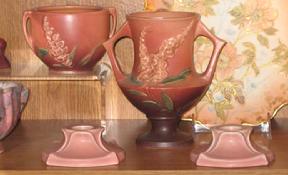
The Pinecone Modern pattern was introduced by Roseville Pottery in 1953. The pattern included 51 shapes including baskets, bowls, planters, vases, ect. The easiest way to identify the Roseville Pinecone Modern pattern is by the shape number. All Pinecone Modern pieces are in the 400 series. Roseville chose to renumber the Pinecone Modern pattern even though numerous shapes were reissues from the identical, original Roseville Pinecone line introduced in 1935.
Most Pinecone collectors actively seek the 400 series Modern pieces with the same level of interest as original Pinecone. In fact, many collectors find the green version of Pinecone Modern more attractive than the original green pinecone primarly because of more vivid coloring and less glaze runs and drips with the later version.
Due to the short period of production for Pinecone Modern, many of the 400 series shapes are harder to find that the original forms. Roseville produced Pinecone Modern from 1953 until the factory was sold in the summer of 1954.
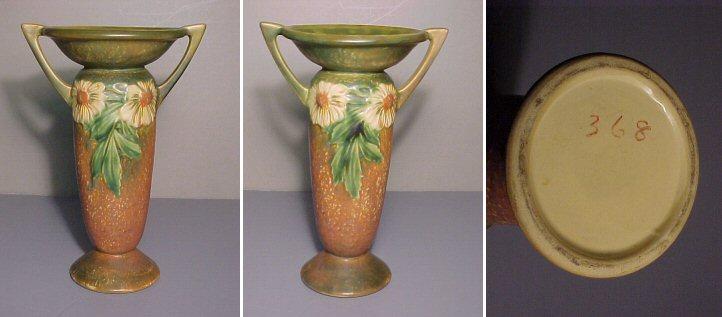
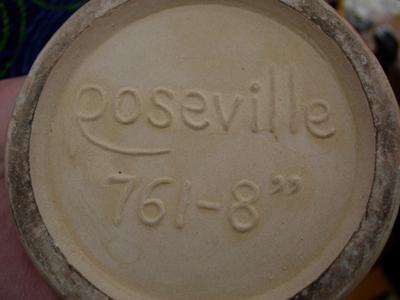
Pinecone Modern is marked with the raised molded Roseville USA mark and with the shape number and size. Some examples are also marked with a die-impressed or raised "Pine Cone". Examples of some of the variations of bottom marks are shown below.


|
About Roseville Pottery
The Roseville Pottery Company was founded in 1890. Roseville initially produced simple utilitarian ware such as flower pots, stoneware, umbrella stands, cuspidors, and limited painted ware. In 1900, Roseville Rozane became the first high quality art pottery line produced by Roseville.
In 1904, Frederick Rhead became art director for Roseville pottery. Rhead was responsible for the production of scarce art pottery lines such as Fudji, Crystalis, Della Robbia and Aztec.
In the early teens as demand for the more expensive, hand-crafted art pottery declined Roseville pottery shifted production to more commercially produced pottery. Roseville's ability to nimbly adapt to market conditions was one of the potteries' greatest attributes as Roseville was continually able to produce the most popular patterns and styles compared to their immediate competitors.
In 1919, Frank Ferrel succeeded Harry Rhead (Frederick's brother) as art director for Roseville pottery. Frank Frerrel and George Krause combined to produce many of today's most popular Rosevilly pottery patterns including Dahlrose, Rosecraft, Hexagon, Ferella.Sunflower, Blackberry, Cherry Blossom and Wisteria.
Roseville pottery introduced Pinecone in 1935. Pinecone became the most successful and highest volume pattern produced during the existence of Roseville pottery. The pattern includes over 75 different shapes in blue, brown, and green.
World War II necessitated another production change for Roseville pottery. During this time period, Roseville introduced such patterns as Fuchsia, Cosmos, Columbine, White Rose, Bittersweet and Zephyr Lily. While these patterns were still the best quality art pottery in the market at this time, it was not enough to save the company. Roseville Pottery ceased operations in 1954.
Throughout Roseville's days of production, its versatility and innovativeness served to keep the company at the forefront of the various decorating styles and buying public trends. Even to this day, Roseville pottery still represents the most widely known and most collectible art pottery ever produced.
Roseville Pottery Marks
The Roseville Pottery Company used many different marks during its existence. The earliest marks used by Roseville pottery were the die-impressed Rozane marks and the wafer marks (Photo 1) associated with the various Rozane patterns. In 1923, Rosevilly pottery started using the blue ink stamp Rv mark that is often seen on patterns such as Roseville Carnelian I, Rosecraft Panel, Rosecraft Vintage, etc. (Photo 2).
Roseville pottery patterns produced between 1927 and 1935 were marked with only paper or foil labels and sometimes with the corresponding shape number and size. Roseville patterns with paper or foil labels include such notable lines as Baneda, Blackberry, Cherry Blossom, Falline, Falline, Futura, Jonquil, Monticello and Sunflower. (Photo 3).
In 1936, Roseville pottery started using the die-impressed trademark Roseville and the corresponding shape number and size in script. Beginning in 1940, Roseville pottery started marking pieces with the more commonly seen, raised Roseville USA along with the corresponding shape number and size. (Photos 4 and 5).
Rosevilly pottery patterns such as Pinecone that was produced over a long period of time often confuse new Roseville pottery collectors, due to the variety of marks used during the pattern's years of production. For example, is possible to find Roseville Pinecone either unmarked; marked with the die-impressed trademark Roseville with the shape number and size; or marked with the raised Roseville USA along with the shape number and size.
|
 |
| Roseville Pottery Index page... |
|
|
Roseville Pottery Marks by Just Art Pottery
|
Our friend Tom recently contacted us with some comments and questions regarding Roseville jardinieres and pedestals. The following is an excerpt of Tom's email:
I have loved and collected Roseville for a long while now. I have never been able to determine something about the Roseville jardiniere and pedestals. Especially as regards the middle period jars and peds, sunflower, blackberry and wisteria. If you consult the references (and I have all the ones you mentioned in your latest excellent article!), you will get conflicting information. Some list an 8 inch, 10 inch, and 12 inch jardiniere and pedestal. Some only list 8 and 10 inch jar and peds and a solo twelve inch jardiniere only. Having never seen the twelve inch jar in sunflower, blackberry, or wisteria I am wondering if it has its own pedestal that is larger than the ten inch jard's pedestal. Or if it was made without a matching pedestal like some of the smaller jardinieres? Or does the twelve inch jardiniere have the same base size as the ten inch jar? Or does it have a bigger base but still is able to sit on the ten inch jard's pedestal. In other words is the ten inch pedestal interchangeable with a ten OR a twelve inch jardiniere? I would like to get the largest jar and ped in the middle period patterns, but would love getting to the bottom of this question before seriously starting purchasing. I have a perfect ten inch jar and ped in the blackberry pattern and love it. But, I am thinking i have seen a larger set about twenty years ago. Or, was I just imagining it?
Tom brings up some very good questions; most of which I can't definitively answer. And he is correct in stating that the available Roseville reference books contradict one another regarding jardiniere and pedestal sizes for various middle period patterns.
I believe that I have seen 12" jardinieres in the Sunflower and Blackberry patterns but not in Wisteria. I don't know the answer to the question of if the 12" jardinieres had their own pedestals or simply used the larger 10" pedestal. My suspicion is that the 12" jardinieres were made without a matching pedestal.
I do not believe the 12" jardiniere has the same base diameter as the 10" jardiniere. However, in my opinion, it is likely that 12" jardinieres were sold by Roseville with the larger pedestal. I believe this because over the years we have purchased several estate collections with relatively odd sized Weller and Roseville jardiniere and pedestals where the family indicated the sets had been together since they were purchased in the 1920s or 1930s. Some of these jardiniere and pedestal sets were so rare that I find it very unlikely the original owner married the pieces together later.
I'm sure some of our experienced Roseville collectors can help shed some light on these jardiniere and pedestal shape and size discrepancies. Clearly the Roseville factory stock pages are incomplete and the available reference books inconsistent.
|
Most Roseville Pottery collectors define "middle period" Roseville Pottery as the lines that were produced between 1920 and 1938. This time line for middle period Roseville patterns covers the years of the company presidencies of Russell Young and Anna Young.
The following Roseville pottery patterns are from the middle period of production and are organized in order of the year each line was introduced by the pottery. Mark Bassett's Introducing Roseville Pottery provides the most accurate information regarding the year each pattern was introduced.
Roseville Pottery middle period patterns introduced between 1920 and 1930
- Dogwood I (textured)
- Rozane Patterns
- Sylvan
- Vista
- Rosecraft Colors
- Imperial I
- Lustre
- Volpato
- Corinthian
- Florentine
- Juvenile
- La Rosa
- Rosecraft Hexagon
- Victorian Art
- Dogwood II (smooth)
- Carnelian I (drip glazes)
- Rosecraft Panel
- Lombardy
- Tuscany
- Normandy
- Cremona
- Dahlrose
- Futura
- Carnelian II (mottled glazes)
- Savona
Roseville Pottery middle period patterns introduced between 1930 and 1938
- Imperial II (glazes)
- Earlam
- Ferella
- Sunflower
- Montacello
- Windsor
- Jonquil
- Baneda
- Blackberry
- Cherry Blossom
- Tourmaline
- Artcraft
- Falline
- Wisteria
- Laurel
- Topeo
- Luffa
- Russco
- Pine Cone
- Velmoss
- Morning Glory
- Orian
- Clemana
- Primrose
- Moderne
- Moss
- Thornapple
- Dawn
- Ixia
- Poppy
- Teasel
- Fuchsia
- Iris
|
|
Roseville Pottery reproduction marks...
|
 |
| Identifying Roseville Repros, By Pamela Wiggins. |
|
|
This is one of many reproduction marks found on fake Roseville Pottery imports. Notice the shape of the "R" in Roseville and the way the letters are straight rather than slanted slightly to the right. While the absence of U.S.A. is a clue to reproduction marks in some cases, it's not always an indicator. You will see a photo of a genuine Roseville U.S.A. mark in the next photo
|
|
Roseville Marks by the Roseville Exchange
The first thing to remember is that anyone can slap a label on something. It doesn't mean ANYTHING to have the words "Roseville" or "Roseville, U.S.A" (Roseville USA is on some of the early fakes) on the bottom of your piece. Even pieces that were not originally marked have Roseville on the bottom to fool people who don't know the difference. In many cases it's difficult to tell just from the mark, you need to get to know the glazes where it becomes very obvious. I'm sure I could tell the difference blind-folded and with time so will you. Never-the-less, I have included some examples below
|
Roseville Pottery
Quality consignment wanted inquire today. (651) 451-0398
| |
Roseville Pottery
Quality consignment wanted inquire today. (651) 451-0398
|
 |
| Roseville Pottery (1) |
|
|
|
 |
| Roseville Pottery (2) |
|
|
 |
| Art Pottery Index |
|
|
To all Visitors
This site has been developed not just to sell Antiques and Collectibles (of course it does some of that) rather it is to provide information about Antiques, Collectibles, artwork, art pottery, furniture types, furniture styles, jewelry, and militaria from the Revolutionary War to the Vietnam War. This site is all about information and history that is not readily available elsewhere on the Internet. We think West St Paul Antiques is one of the best Antique Malls in the State of Minnesota and we have been working hard to create that excellence for the last 12 years. We have expertise on Antiques & Collectibles and as we read and study about history and antiques we also strive to be historians. We will share that expertise with you and all the visitors to our site. Stop by and visit our Antique Mall in West St Paul, Minnesota. Or, you are all welcome to visit us on the web. This is a new website for us at West St Paul Antiques. We hope you enjoy the site. Please feel free to email me directly at floydruggles@weststpaulantiques.com if you have any questions or feedback about this site. Please sign our guest book and check out our Poetry Coffee Cup Cafe, or the Out and About Gallery. The Reference Library an all 5 Museums are open to you 24/7 on this website. Stop by one of the 1st Recon Battalion pages where you can read about my experiences in Vietnam. Oh, by the way, also check out all our Antiques, Collectibles, artwork, art pottery, clocks, mall specials, furniture types and styles, jewelry and militaria items for sale on this site and in our Antique Mall. Check it out by going to Antique Mall Tour. This site will be totally commercial free with no fees to pay. I'll be working on this site over time so bear with me. It should be finished by the end of 2010 with over 500 pages at that time and 900 pages by the end of next year. Click here to go to our web Site Map and Categories.
|
Click a NEW link To browse our Home page, Look over our Museums, 1st Reconnaissance Battalion pages, Recon Photo Gallery, Out and About Gallery, Poetry Coffee Cup Cafe, About Us, Christmas Index, Antique Mall Tour, Antiques & Collectibles, Furniture, Jewelry, Art Pottery, Artwork, Militaria,Contact Us, Hours and Directions, Dealers pages, Consignment, Ebay Store, Translate this Website, Our Blogs, Books, Bottles & Jars, China, Crystal & Glass, No Man Left Behind, Who Was Really the First President of the United States, Halloween pages, Primitives, Antique Photos, The Day Eagle Cried, Financial Tip of the Year & Remembering The 50's & 60's Music Index.
or
Go to the top of each page of our website for the menu bar of categories. You will see a drop down menu appear for each category. Click a link to browse or click our Site Map and Categories to find your link. Copyright © 2009 -2010 West St. Paul Antiques All Rights Reserved. © 2009-2010 West Saint Paul Antiques All Rights & Media Reserved. © 2009-2010 1st Recon Bn.Com All Rights & Media Reserved.
|
Thanks for stopping by
If you need Immediate Assistance please call today.
(651) 451-0398

|
 |
| Email me with your feedback on how I can Improve this website. |
|
|
|